AI and the Human Body: How Are They Similar?
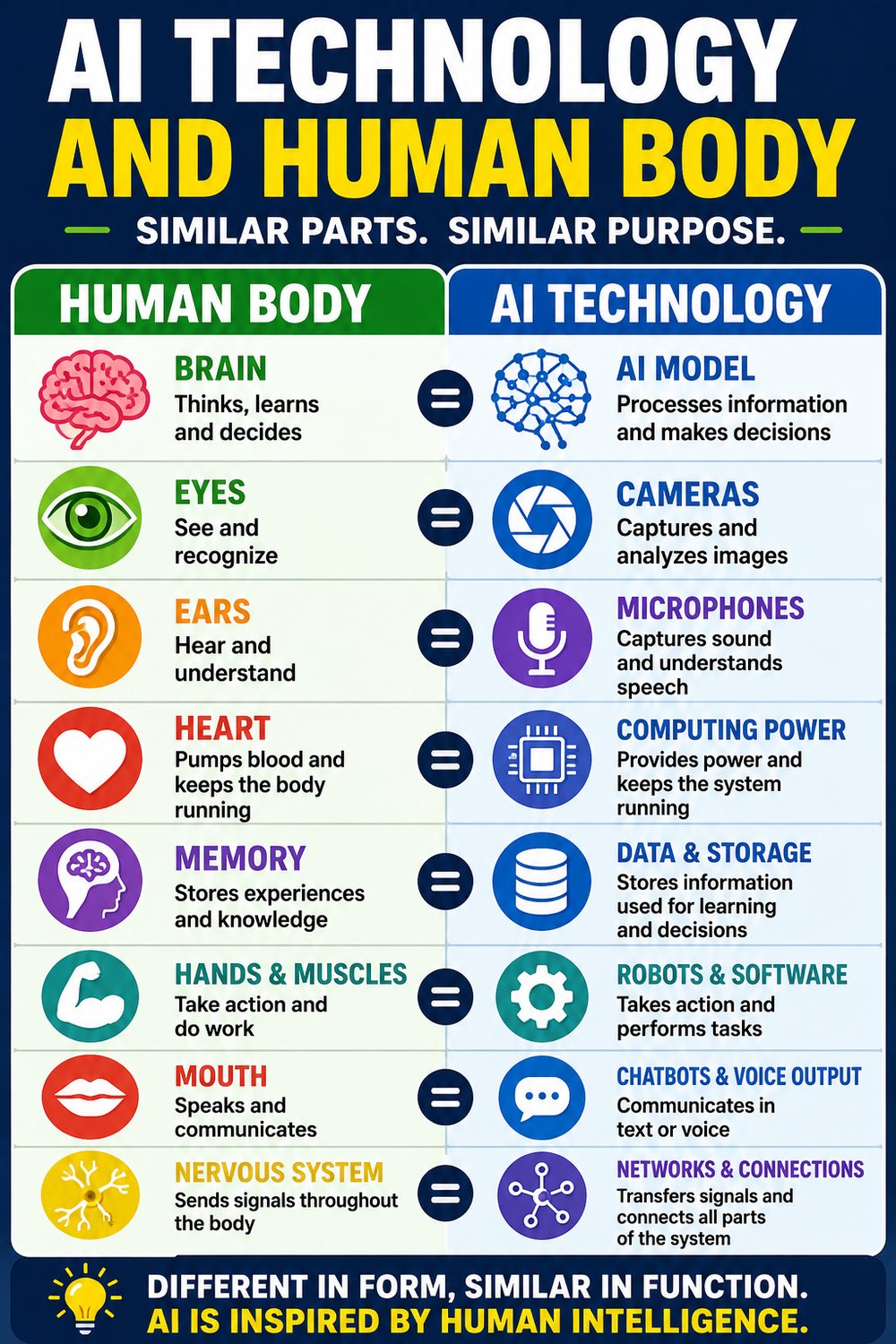
Artificial Intelligence can understand questions, recognise images, learn from information and communicate with people. Using the human body as a comparison makes AI far easier to understand — as long as you also know where the comparison breaks down.
AI as a human body
Artificial Intelligence, or AI, can sometimes feel like a human. It can understand questions, recognise images, learn from information, make decisions and communicate with people. But how does AI actually compare with the human body and human intelligence?
AI is not a living person, and it does not have a human brain or emotions. However, we can use the human body as a simple way to understand how the technology works. Think of an AI system as a digital version of a body: different parts perform different jobs, just as different parts of our body do.
How to use this comparison: It is a teaching tool, not a scientific claim. It helps you picture what each part of an AI system does — but AI and the human body work in fundamentally different ways underneath.
1. The AI model is like the brain
The human brain receives information, processes it, recognises patterns and helps us make decisions.
An AI model performs a similar role. It processes large amounts of information and uses patterns it has learned to generate an answer or perform a task. For example, when you ask a chatbot a question, the AI model processes your words and generates a response.
- Human brain
- Thinks and processes information.
- AI model
- Processes information and generates results.
2. Data is like memory
Humans learn from education, experiences, conversations, books and the world around them. These experiences become part of what we remember and use later.
AI also depends heavily on data. AI models are trained using large amounts of information so they can recognise patterns and perform tasks.
- Human
- Learns from lived experience.
- AI
- Learns patterns from data.
However, an AI's "memory" is not the same as human memory. It works through computer systems, stored information and mathematical models rather than recollection.
3. Cameras and microphones are like our eyes and ears
Humans use their eyes to see and their ears to hear. AI systems can use cameras, microphones and other sensors to collect information.
For example, facial recognition uses a camera to capture an image, and a voice assistant uses a microphone to receive your voice.
- Human eyes
- See.
- AI camera
- Captures and analyses images.
- Human ears
- Hear.
- AI microphone
- Captures sound.
4. AI communication is like our mouth
Humans use their mouth and voice to communicate with others. AI can communicate through text, speech, images and other forms of output.
For example, a chatbot can answer your question in text, while a voice assistant can speak the answer aloud.
- Human
- Speaks to communicate.
- AI
- Generates text or speech to communicate.
5. Computer networks are like the nervous system
Our nervous system carries signals between different parts of the body. It allows the brain to communicate with everything else.
In AI systems, computer networks and communication systems move information between computers, servers, applications and other components. This is what allows the separate parts of a digital system to work together as one.
6. Robots are like the hands and muscles
Humans use their hands and muscles to perform physical actions. AI can control robots and machines that perform physical tasks.
For example, AI-powered robots can move objects, inspect products on a production line or assist in factories.
- Human
- Intelligence plus a body allows physical action.
- AI
- Software plus robotics allows physical action.
7. Learning is similar, but not the same
Humans and AI can both improve through learning. A child may learn to identify a dog after seeing many dogs, gradually recognising the common features. An AI model can also learn patterns from many examples, and after training on large amounts of data it can identify objects, understand language or generate content.
The important difference: humans learn through real-life experience, senses, emotions and consciousness. AI learns through data, training methods and mathematical models. The outcome can look similar; the process is not.
A simple example
Imagine you show a picture of a cat to both a person and an AI system.
A human might think
AI might work like this
The final answer may be the same, but the route each takes to reach it is completely different.
AI is powerful, but humans are different
Comparing AI to the human body helps us understand the technology, but we should not conclude that AI is a kind of person.
Humans have emotions, consciousness, creativity, personal history, instincts and biological needs. AI has no biological body and no human consciousness. It processes information using computers, algorithms, models and data.
AI can be extremely capable at specific tasks — often far faster than a person — but human intelligence is much broader, and it is grounded in lived experience that no dataset contains.
The simple picture
The whole comparison fits into one table.
| Human body | AI system |
|---|---|
| Brain — thinks | AI model — processes information |
| Eyes — see | Cameras — capture images |
| Ears — hear | Microphones — capture sound |
| Body — keeps everything working | Computers — run the system |
| Memory — remembers and learns | Data — provides the information |
| Hands — take action | Robots — take action |
| Mouth — communicates | Chatbots and voice AI — communicate |
Conclusion
AI may look nothing like the human body, but comparing the two makes it far easier to understand. The AI model is like the brain, data is the source of what it has learned, cameras and microphones work like our senses, networks let information travel, and robots or software carry out actions.
The comparison also carries a useful warning. AI borrows some ideas that were inspired by human intelligence, but it is not a human being.
In simple words: AI is a powerful technology that can perform some tasks which require intelligence, while humans remain living, thinking, feeling beings.
Key takeaway: use the body comparison to understand what each part of an AI system does — then remember that the similarity is in the job being done, not in how it is done.
About the writer
Thank you for reading this article on Artificial Intelligence and human intelligence. I publish easy-to-understand articles covering Artificial Intelligence, prompt engineering, SEO, content writing, health, nutrition, emerging technologies and digital productivity.